Normal distributions
Outline
Topics
- Quick review of the normal distribution.
- Different parameterizations.
Rationale
The normal distribution is often used in Bayesian analysis when one needs a prior over an unknown \(x\) such that \(x \in (-\infty, \infty) = \mathbb{R}\).
Definition
A probability density \(f\) is normal (or Gaussian) when its logarithm is a degree two polynomial:
\[f(x) \propto \exp(\text{polynomial of degree two in }x).\]
Examples of normal densities
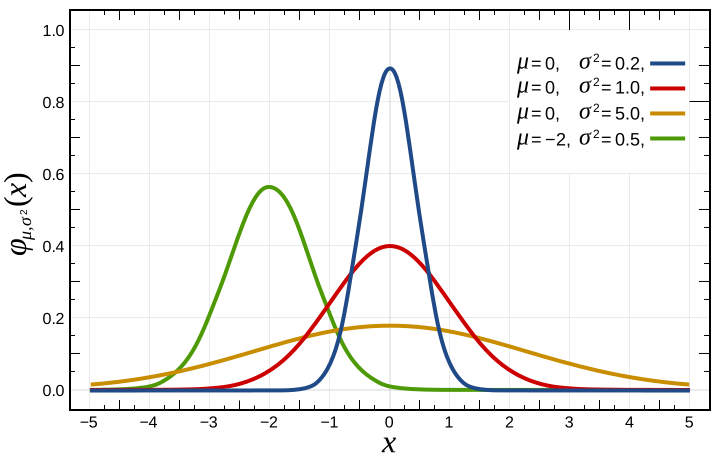
Parameterizations
- There are different conventions to measure the spread.
- Standard deviation \(\sigma\).
- Variance, \(\sigma^2\).
- Precision, \(\tau = 1/\sigma^2\).
- Keep that in mind as different languages will use different conventions!
- Standard deviation is the most intuitive:
- it is the width of the bell,
- the only one that has the same units as \(x\) (e.g. if \(x\) is in meters, so is \(\sigma\)).
Density for variance \(\sigma^2\) and mean \(\mu\):
\[f(x) \propto \exp\left( - \frac{(x - \mu)^2}{2\sigma^2} \right).\]
Multivariate version
Exact same definition: A joint probability density \(f\) is multivariate normal when its logarithm is a degree two polynomial:
\[f(x_1, x_2, \dots, x_d) \propto \exp(\text{polynomial of degree two in }x_1, x_2, \dots, x_d).\]
In the multivariate case the most popular parametrization is the generalization of variance, the covariance matrix.
Unfortunately, the covariance is almost always denoted \(\Sigma\), which is the capital letter for \(\sigma\), but really it is the generalization of \(\sigma^2\), not of \(\sigma\)! We will stick to the standard notation.
Density: where \(x = (x_1, x_2, \dots, x_d)\),
\[f(x) \propto \exp\left( - \frac{1}{2} (x - \mu)^{\text{T}} \Sigma^{-1} (x - \mu) \right).\]